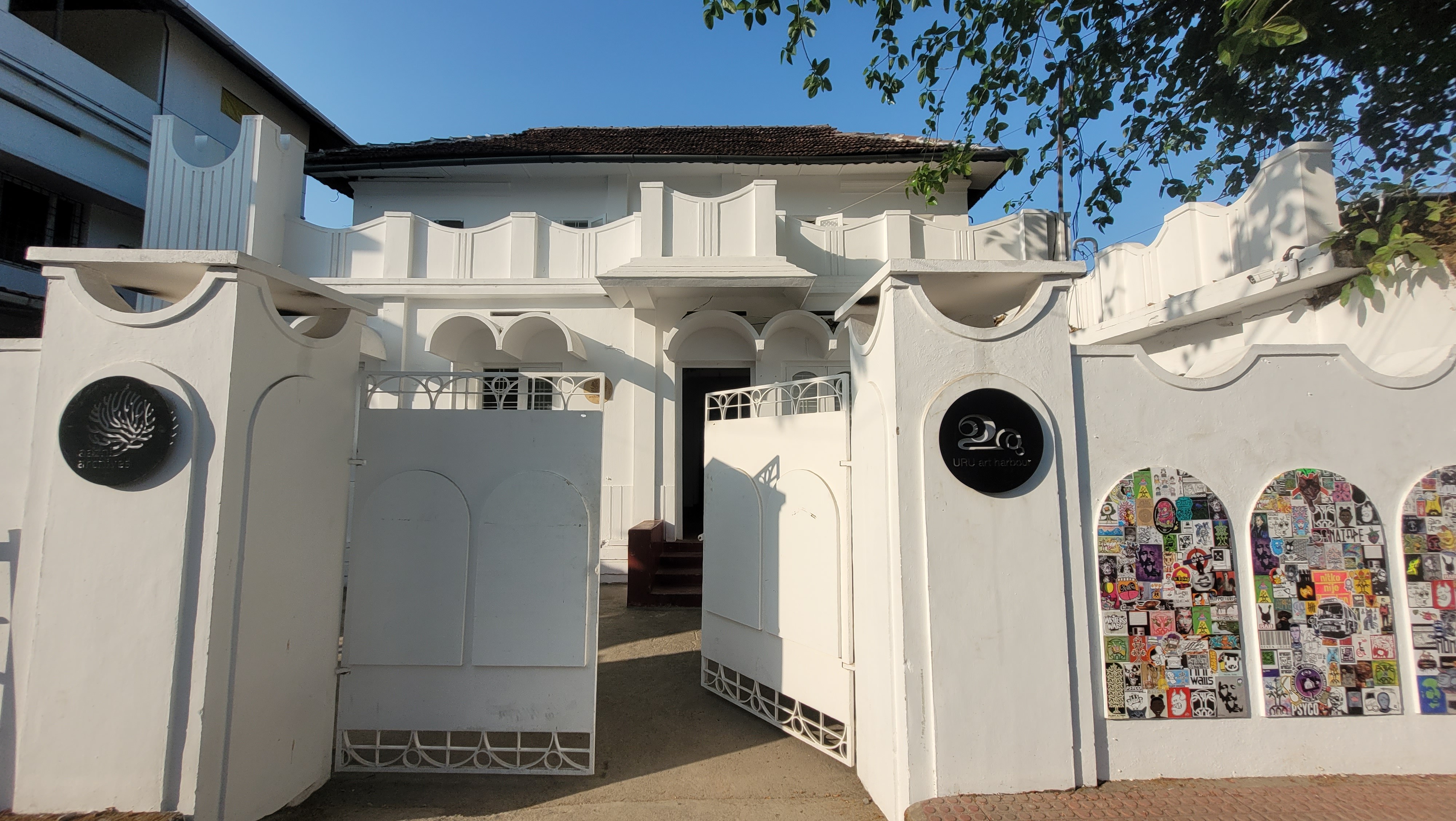

Amphibian Aesthetics is on view at Ishara House at Kashi Hallegua House until 31 March 2026.
Like a creature rising from the depths after years underwater, the idea of Amphibian Aesthetics surfaced gradually. Its roots stretch across more than a decade of work in Kochi’s coastal neighbourhoods, beginning with projects that traced Kerala’s long and complex relationship with the Indian Ocean world. Among these formative explorations were the Mattancherry Project (2016) and the exhibition Sea a Boiling Vessel (2022), both of which turned our attention repeatedly toward water as the central medium of Kerala’s historical imagination.
Water, the starting point
For us, the ocean was never a backdrop. It was the engine of history itself. Trade, migration, slavery, religious circulation, and cultural exchange arrived across these waters, shaping not only the region’s economy but its social and spiritual life. Tide, climate, and coastal precarity shaped worldviews. Through residencies, archival work, and community research, we came to recognise that Kerala’s maritime past offered an alternative lens for understanding the present. One that foregrounds movement, porosity, and entanglement.
Reversing the gaze
Our perspective shifted when we began to reverse our gaze. We stopped looking at the sea from land, as is common in the history books that we have all been taught. We started looking at land from the vantage of the sea.
This inversion made visible a different kind of history. One defined by continuous arrivals and departures, permeable borders, and life lived at thresholds. It was in this fluid, in-between space that the figure of the amphibian began to take shape: not simply as an animal, but as an archetype of adaptability and uncertainty.
In a time marked by climate instability, displacement, and political fracture, the amphibian felt less like a symbol and more like a condition of contemporary life. Increasingly, we all occupy multiple worlds at once. We are moving between identities, geographies, and states of stability and upheaval. This recognition gradually informed our curatorial thinking.
A partnership across shared waters
By the time Ishara Art Foundation approached our founder, artist Riyas Komu, to lead its India extension, the ‘amphibian’ idea had started to become central to our ongoing research. The partnership, thus, felt intuitive. Ishara, based in Dubai, shares a deep connection with Kerala through decades of migration and cultural exchange. These shared oceanic ties made it a fitting collaborator as the inquiry expanded into the first exhibition at Ishara House, housed inside a 200-year-old Jewish heritage building in Mattanchery. A perfect site shaped by layered histories of arrival and coexistence.
Amphibious thinking as a curatorial approach
Amphibian Aesthetics is not simply an exhibition built around a metaphor. It proposes a way of thinking that resists rigid categories. Of the East and West, land and sea, past and present. This has even informed the selection of artists whose practices naturally inhabit hybrid or transitional zones. Engineers, space researchers, musicians, architects, comic artists, filmmakers, poets, and painters appear alongside one another, each contributing to a collective inquiry rather than just ticking a box of representation.
Take, for instance, Michelangelo Pistoletto’s work using broken mirrors, which dissolve the boundaries between viewer and artwork, prompting reflection that is both literal and social. Or Palestinian artist Dima Srouji’s exploration of bathtubs repurposed as protective shelters in Gaza, revealing how domestic architecture transforms in moments of crisis. Or CAAS (City as a Spaceship), who investigate how humans might live in remote environments by understanding Earth and space as a continuous field. Each of these practices traverses multiple realities, embodying the amphibious sensibility that lies at the heart of the exhibition.
A city that fosters amphibious thinking
Kochi’s geography and social fabric reinforce this curatorial proposition. Here, more than thirty communities have lived together within a three-square-kilometre stretch for decades, forming a dense mosaic of languages, rituals, and memories. This coexistence is not theoretical. It is lived daily, shaped by centuries of negotiation, labour, and environmental exposure.
Spatially, the exhibition mirrors this condition. Works extend into the city, onto walls, along streets, and toward the waterfront, encouraging visitors to encounter art within Kochi’s humid air, its spice-scented warehouses, and its tidal rhythms. The city itself becomes an active collaborator, blurring the boundaries between the gallery, the neighbourhood, and the sea.
An evolving inquiry
Amphibian Aesthetics is, thus, a story of ideas gradually finding form through place, people, and practice. It is a story shaped by the ocean’s logic. It is fluid, unpredictable, and generative. And it continues to evolve through the conversations unfolding at Ishara House, informing future research, collaborations, and exhibitions.
In this sense, Amphibian Aesthetics is not a conclusion but an invitation. To rethink how we inhabit an unstable world, to embrace porousness rather than certainty, and to consider that survival today may require becoming a little more amphibious ourselves.