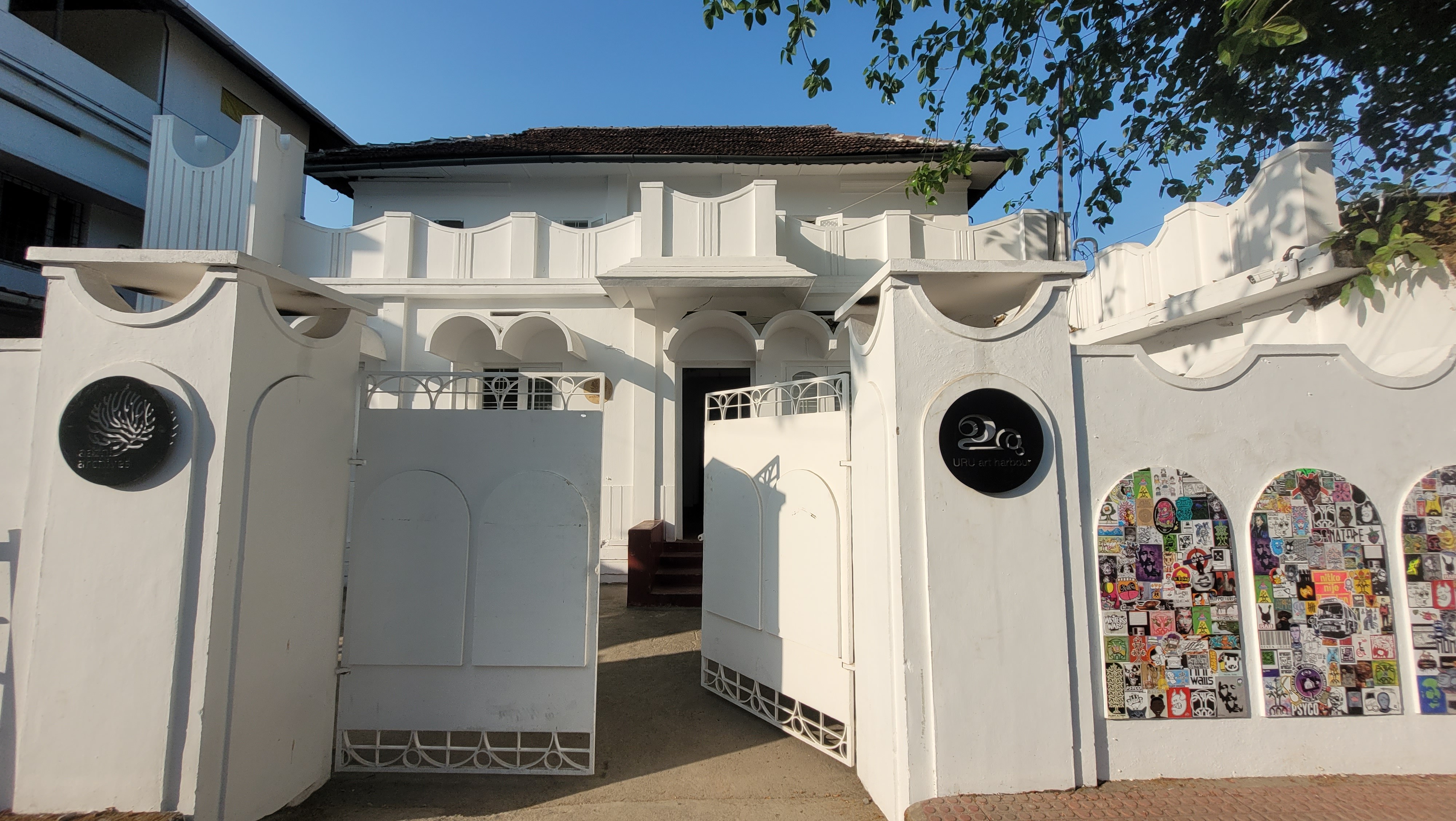
Welcome to Kochi. Here, histories exist layered like sediment, shaped across centuries of migration, faith, and trade. People and stories come from around the world, stay awhile, leave their mark, and make this city their own. For us at Aazhi Archives, Kochi was never just a location; it was the only place where our work could have taken root.
Aazhi Archives is not an institution in the traditional sense, nor solely an arts organisation. Instead, we function as a living network. One that insists that art is inseparable from knowledge, and knowledge is inseparable from the people who carry it. Art + Knowledge + People is not a slogan for us. It is the way we work. Every project emerges through a collaborative weaving of scholarship, fieldwork, artistic experimentation, and the lived memory of communities.
“People are repositories, protagonists, destinations, and custodians of the knowledge that emerges through these processes,” says Riyas Komu, the founder of Aazhi Archives. “Our collective formed organically, shaped by the intellectual and artistic interests of its members. What brought us together was a shared curiosity about Kerala’s deep entanglement with the Indian Ocean world and a desire to explore how these histories continue to shape contemporary life.”
Our journey began with site-specific initiatives like the Mattancherry Project (2016), which encouraged us to look closely at the cultural and ecological life around Kochi’s harbour settlements. These early efforts made it clear that we were not simply staging art projects—we were entering into conversation with a landscape shaped by migration, caste histories, labour, climate, and the sea. Exhibitions, workshops, research grants, and residencies followed, each one extending our inquiry into how communities endure precarity, how memory is preserved, and how water shapes identity in ways both visible and invisible.
At Aazhi Archives, our projects often begin with lingering questions, like: What is the relationship between Kerala and the Indian Ocean? How have slavery, trade, and migration shaped local memory? How do people in Kochi inhabit a space where more than thirty communities have lived closely for centuries? And how can contemporary art illuminate the ecological urgencies unfolding in real time?
These questions demand both historical grounding and local intimacy, which is why our work repeatedly returns to neighbourhoods like Mattancherry, Fort Kochi, and the harbour edges. These are spaces where fishermen, spice traders, migrants, and craftspeople shaped a unique cosmopolitanism long before the word became fashionable. Here, memory is not abstract. It is held in objects, stories, smells, architectural traces, and sensory rhythms of daily life.
Our first major project, Sea a Boiling Vessel (2022), dug into maritime histories of slavery, trade, and displacement. Our earlier initiatives through Uru Art Harbour had shown us that art and research gain depth when communities become interlocutors and sometimes even co-creators.
This blending of scholarship and lived experience forms the foundation of our flagship exhibition, Amphibian Aesthetics, in collaboration with Ishara Art Foundation. In this exhibition, our role extends beyond curating objects; it is conceptual, sometimes philosophical.
The amphibian emerged for us after years of research as a metaphor for the slippery realities of today, like climate collapse, displacement, extinction, and political precarity. But it is also a metaphor rooted in Kochi’s own amphibious histories: its shifting relationship between land and water, its openness to the world, and its capacity to reinvent itself through crisis.
In shaping the exhibition, we invited artists from multiple disciplines. Some of them are engineers, some architects, a few poets, some filmmakers, and a few others painters. This selection wasn’t made to represent categories, but to contribute to a collective thinking process. Their works enter into conversation with each other and with the city. Several occupy public space: walls, waterfronts, and neighbourhood corners. This is central to our ethos that knowledge must circulate. It should not remain confined within formal institutions.
In our view, art is not an object. It is a process of inquiry, and inquiry is always rooted in people. This is why Amphibian Aesthetics bridges historical narratives with contemporary urgencies. It invites viewers to consider how water holds memory and how communities adapt to precarity. How everyday objects, from bathtubs in Gaza repurposed as protective architecture to ship hulls in Kochi’s docks, carry the weight of survival and resilience.
Our decade of work shows that the boundaries between art, scholarship, and civic life need not be rigid. In Kochi, they never were. Communities have long lived within a cultural ecology shaped by arrival and departure, vulnerability and endurance. We believe that the role of Aazhi Archives is to help translate this lived complexity into visual, sonic, textual, and conceptual experiences that resonate both locally and globally.
Art + Knowledge + People is not a formula. We consider it a practice of care. Care for history, care for the environment, care for community memory, and care for the fragile coexistence that defines life in Kochi. In a world where binaries collapse and certainties dissolve, we propose a different way of thinking. One that is collaborative, responsive, and open to the fluidities that shape both our present and our future.